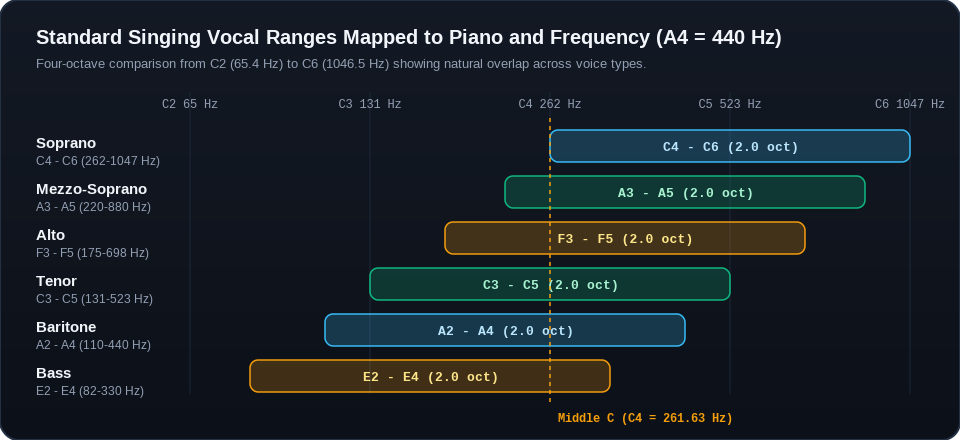
Complete Vocal Range Chart Summary Table (Notes & Hz)
A vocal range chart maps the six standard singing voice categories—Bass, Baritone, Tenor, Alto, Mezzo-Soprano, and Soprano—onto piano keys and exact frequencies in Hertz (calibrated to international concert pitch A4 = 440 Hz). Use the interactive matrix above to hear every boundary note directly in your browser, or scan the quick-reference summary table below:
| Voice Type |
Standard Note Range |
Frequency Span (Hz) |
Sweet Spot (Tessitura) |
Key Register Bridge (Passaggio) |
| Soprano |
C4 – C6 |
261.6 – 1046.5 Hz |
E4 – A5 |
E4 / F#5 |
| Mezzo-Soprano |
A3 – A5 |
220.0 – 880.0 Hz |
C4 – F5 |
E4 / E5 |
| Alto (Contralto) |
F3 – F5 |
174.6 – 698.5 Hz |
A3 – D5 |
D4 / D5 |
| Tenor |
C3 – C5 |
130.8 – 523.3 Hz |
E3 – A4 |
D4 / G4 |
| Baritone |
A2 – A4 |
110.0 – 440.0 Hz |
C3 – F4 |
B3 / E4 |
| Bass |
E2 – E4 |
82.4 – 329.6 Hz |
G2 – C4 |
A3 / D4 |
Each classical benchmark spans exactly 2.0 octaves (24 semitones)—the core working range expected for clear projection in choral and solo repertoire. Contemporary singers who blend chest, mixed, and head/falsetto registers often span wider total ranges while still centering their best tone inside one of these six sweet spots.
How to Find Your Vocal Range Step by Step
If you have never measured your singing voice before, learning how to find your vocal range takes less than five minutes and requires no music theory background:
- Start around Middle C (C4) or C3: Tap
C4 (261.6 Hz) on the interactive keyboard above for higher voices, or C3 (130.8 Hz) for lower voices, and sing an easy, relaxed "Ahhh" to match the tone.
- Walk downward step by step for your lowest note: Move down one white or black key at a time (
B, Bb, A, Ab...) until the pitch turns breathy or breaks into rough vocal fry. The last note you can hold steadily with clear tone is your lowest usable note.
- Return to the middle and walk upward for your highest note: Climb cleanly without lifting your chin or tightening your throat. Note two landmarks if you like: your highest comfortable chest/mixed note, and your highest clear head voice or falsetto note.
- Verify automatically with a microphone: Prefer instant precision without hunting for keys by ear? Open the live NoteGauge Vocal Range Test to detect your exact low note, high note, octave span, and matching voice type automatically.
- Check pitch steadiness along the way: If a high or low note feels borderline, open our Online Pitch Detector to verify whether you are hitting the target pitch cleanly within ±15 cents rather than sliding flat underneath it.
Why Overlap Happens: Range vs. Tessitura vs. Vocal Timbre
One of the most common surprises when singers read a vocal range chart is noticing how dramatically voice types overlap. A Baritone (A2–A4) and a Tenor (C3–C5) share 21 semitones from C3 through A4. Likewise, an Alto (F3–F5) and a Soprano (C4–C6) share a full 17 semitones from C4 through F5.
Because of this overlap, vocal coaches look at three factors together—not boundary notes alone:
- Tessitura (Comfort Zone): If you can sing up to
A4, ask yourself whether sitting on F4–G4 for an entire three-minute chorus feels buoyant and energized (typical of a Tenor) or heavy and fatiguing (typical of a Baritone).
- Passaggio (Register Transition Points): Every voice experiences acoustic shift points where resonance transitions from chest dominance into mixed voice and head voice. The notes where those shifts occur are often stronger clues to your voice type than an occasional high note squeezed out on a good day.
- Vocal Timbre (Color & Weight): Some voices naturally carry darker, thicker acoustic weight even on higher notes (such as a dramatic baritone or rich contralto), while others sound bright, agile, and crystalline even in their lower register.
Vocal Registers Explained Simply
Understanding the four main vocal registers helps you interpret any vocal range chart accurately:
- Vocal Fry (Pulse Register): The lowest creaky vibration below your modal chest range. Useful occasionally as a stylistic pop effect, but usually excluded from standard singing range measurements.
- Chest / Modal Voice: Your primary speaking and full-bodied singing register, driven by thicker vocal fold closure and warm lower-harmonic richness. Curious where your natural speaking voice sits inside your chest register? Try our 10-Second Voice Hz Test.
- Mixed Voice: The balanced bridge blending chest fullness with head-voice ease across the upper middle range, allowing contemporary singers to carry power smoothly past their first break.
- Head Voice & Falsetto: Lighter, stretched vocal fold coordination that unlocks notes above your chest ceiling cleanly and safely without shouting.
Tips for Growing Your Usable Range Safely
Consistent daily habits expand usable singing range far faster than pushing for high notes once a week. Hydrate before singing, begin with gentle semi-occluded vocal tract exercises (like humming or straw phonation), keep your larynx neutral as pitch rises, and log your progress monthly using the Vocal Range Test. Even gaining two clean, resonant semitones at the top of your comfortable tessitura dramatically opens up new song keys and repertoire.