
What Does a Voice Hz Test Measure?
A voice Hz test measures the fundamental frequency (F0) of your speaking voice in Hertz—the exact number of times your vocal folds open and close per second while you speak. If your median speaking pitch is 120 Hz, your vocal folds vibrate 120 times every second during voiced speech sounds, corresponding roughly to the musical note B2. If your median is 210 Hz, they vibrate 210 times per second, sitting close to G#3.
While singing tools track extreme high and low musical notes, a speaking voice pitch analyzer focuses on your everyday conversational center of gravity. Measuring your voice in Hertz over a 10-second natural passage reveals three distinct dimensions of how your voice sounds to listeners: your median pitch (how deep or bright your voice sits overall), your 10th–90th percentile speaking range, and your pitch spread in semitones (whether your delivery sounds calm and grounded or highly animated).
Speaking Voice Hz Reference Chart
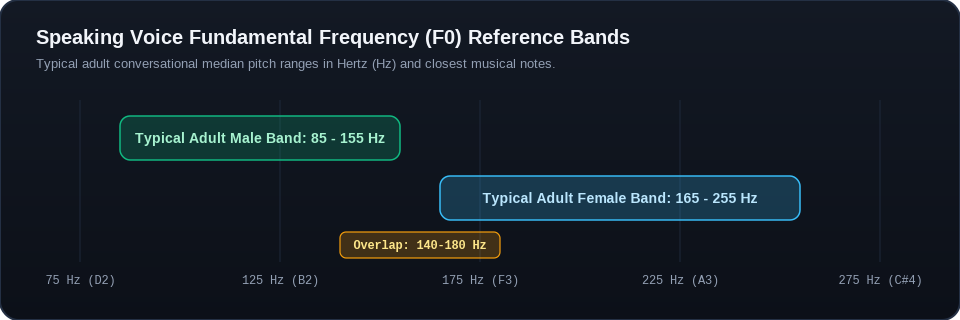
Human vocal anatomy varies widely based on vocal fold length, thickness, and vocal tract resonance, so healthy speaking voices span a broad spectrum. The table below summarizes common conversational fundamental frequency bands used in acoustic phonetics:
| Speaking Band | Median Frequency (Hz) | Nearest Musical Notes | Typical Acoustic Impression |
|---|---|---|---|
| Ultra-Deep Resonance | 55 – 95 Hz | A1 – G2 | Exceptionally low sub-bass warmth |
| Deep Voice | 95 – 120 Hz | G2 – B2 | Rich low male conversational band |
| Warm Low-Mid | 120 – 150 Hz | B2 – D3 | Grounded, relaxed baritone-leaning speech |
| Balanced Mid | 150 – 185 Hz | D#3 – F#3 | Male/female overlap zone; warm & clear |
| Bright Mid-High | 185 – 225 Hz | F#3 – A3 | Classic adult female conversational band |
| High & Light | 225 – 300 Hz | A#3 – D4 | Crisp, agile upper conversational pitch |
Remember that perceived voice depth is not just Hertz alone. Vocal tract resonance (formant frequencies) plays an equally big role: two speakers can both measure exactly 125 Hz, yet the speaker with richer chest resonance and relaxed pharyngeal space will sound noticeably deeper and fuller than someone speaking with tight, nasal tone.
How to Get a Reliable Reading in 10 Seconds
Follow these simple acoustic guidelines to get an honest baseline reading:
- Use the neutral reading script first: The default Rainbow Passage prompt on NoteGauge is a classic phonetics test sentence containing a balanced mix of English vowels and voiced consonants. Reading aloud prevents the artificial pitch shift that happens when you try to "perform" a deep voice.
- Keep natural posture and breathing: Slouching compresses your diaphragm and subtly pushes pitch upward; tucking your chin tightly downward forces throat tension. Sit or stand comfortably with relaxed shoulders.
- Avoid speaking directly into a mic capsule: Hold your phone or sit 20–30 cm away from your laptop microphone so breath pops (
pandbplosives) do not trigger false low-frequency spikes. - Test at two different times of day: If you are tracking vocal training or podcast voice consistency, take one 10-second measurement in the morning and one in the afternoon to see your true everyday baseline.
Voice Pitch Stability and Expressiveness for Speakers & Podcasters
Many podcasters, presenters, and voiceover learners assume "deeper is always better." In reality, listeners engage far more strongly with controlled pitch variation than with a flat monotone—even a very deep one.
- Under 2.5 semitones (Calm & Steady): Works well for meditation, technical briefings, or calm narration, though adding slight emphasis on key words prevents listener fatigue.
- 2.5 to 5.5 semitones (Natural Conversational): The sweet spot for podcasts, presentations, interviews, and teaching—warm enough to feel authoritative, varied enough to hold attention.
- Above 5.5 semitones (Dynamic & Expressive): Common in storytelling, acting, and energetic video hosting.
Healthy Ways to Improve Vocal Resonance (Without Forcing Lower Hz)
One common mistake people make after seeing their speaking frequency in Hertz is trying to artificially press their larynx down to chase a lower number. Forcing your pitch below your natural anatomical range restricts airflow, triggers rough vocal fry, and causes throat fatigue within minutes.
Instead, speech coaches and broadcast vocalists focus on acoustic resonance—making your natural fundamental frequency sound richer, clearer, and more authoritative without lowering it by force:
- Breathe low and speak on steady air: Running out of breath at the end of sentences causes your voice to either collapse into creaky fry or tense upward. Pause naturally at punctuation marks to reset airflow.
- Relax your jaw and open the back of your mouth: Slightly more vertical space inside the vocal tract lowers upper formant frequencies, giving your voice warmer chest presence even at the exact same median Hz.
- Warm up with gentle humming before calls or recording: Thirty seconds of relaxed closed-mouth humming (
Mmm) centered around your comfortable speaking pitch balances vocal fold vibration and clears morning stiffness. - Check room acoustics and mic proximity: A cheap laptop mic placed across an echoey desk strips away low-frequency warmth. Moving within 20–30 cm in a soft-furnished room captures your true acoustic fundamental cleanly.
Speaking Hz vs. Singing Vocal Range
Your speaking fundamental frequency usually rests in the lower quarter to lower third of your comfortable singing chest register. Knowing your speaking Hz gives you a great starting reference for music practice, too. Ready to find out how high and low you can actually sing—and whether you classify as a Bass, Baritone, Tenor, Alto, Mezzo-Soprano, or Soprano? Jump right into our Free Online Vocal Range Test or compare every category on the interactive Vocal Range Chart.